When a cloud vault's backend goes down, the vault goes with it. Veridenti keeps working — by architecture, not by promise.
Every device holds a complete encrypted vault that works offline. Every pinned region can run a live in-jurisdiction replica — even on a second cloud provider. And where physics or law set a hard limit, we tell you exactly where it is.
First principles
Durability and availability are different problems. We solve them separately.
Most continuity conversations blur the two. We split them — because one is effectively solved, and the other deserves real engineering.
Could your data be permanently lost? No.
Eleven-nines-class object storage, a control plane with 30-day point-in-time recovery, and — most importantly — a complete encrypted copy of every vault on every user's device. Even a total loss of all server-side data leaves every user with a working vault to rebuild from. This holds on every plan, with nothing to configure.
Could an outage take you offline? That's what we engineer against.
A region blip, a provider incident, a severed cable — temporary outages are the risk that actually matters, and they're where the machinery on this page lives: offline-first clients, dual-written replicas, automatic failover, and continuous probing.
The practical result: a Veridenti outage is a sync delay, never a lockout — and never a data loss.
Always on — every plan, every tier
What every deployment gets
Three protections are simply inherited. For most organizations there is nothing to configure — redundancy is the default, not an add-on.
Offline-first client
A backend outage is never a lockout. Reads come from the local encrypted vault; writes buffer on-device and reconcile automatically when the backend returns. Most cloud vaults are unusable the moment their servers are — ours isn't.
Platform redundancy
The application tier runs across a global edge with no single region to fail, and default vault storage is multi-region redundant. Redundancy is inherited, not assembled.
Point-in-time recovery
The control plane supports 30-day continuous restore — recovery from accidental deletion, a bad migration, or corruption without a backup-restore project. There is no nightly backup job to fail.
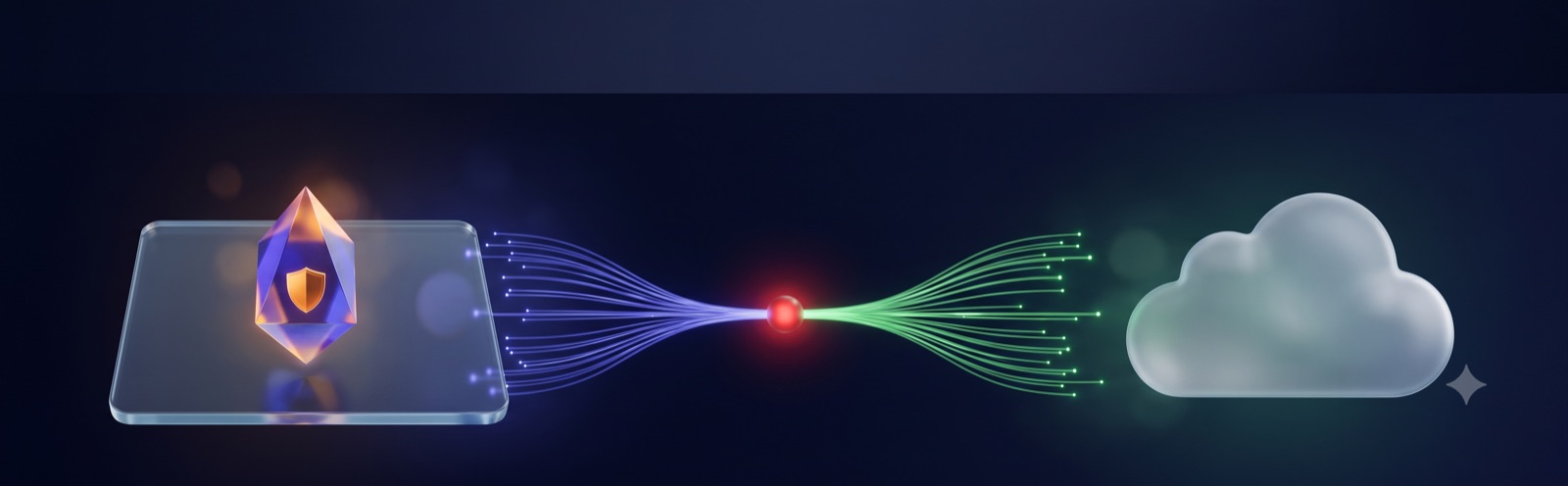
In-jurisdiction disaster recovery Enterprise · pinned regions
DR that never crosses a border
Data residency in 20+ countries — including bring-your-own buckets — pins your ciphertext to one jurisdiction. Pinning creates a continuity question: you cannot fail over across a border without breaking residency. Our answer is a live DR replica inside the jurisdiction, dual-written on every change.
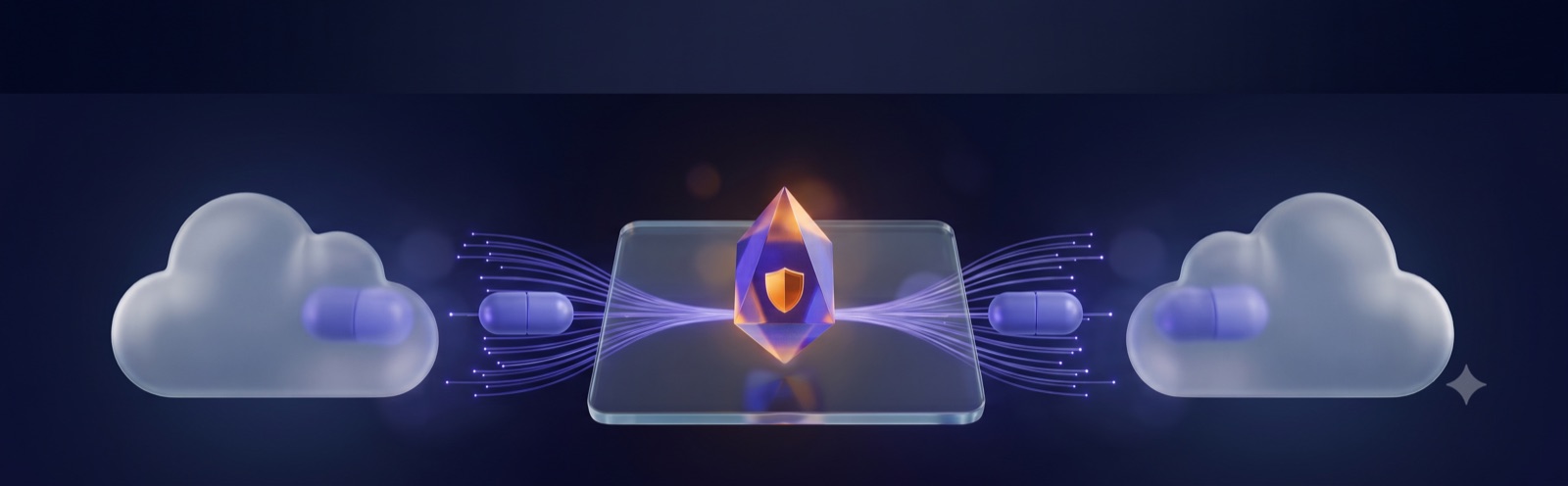
- Dual-write. Every change is written to the primary and the in-jurisdiction replica — a live second copy, not a periodic backup.
- Automatic read-failover. If the primary is unreachable, reads shift to the replica with no operator action.
- Writes never fail closed. During a primary outage the replica becomes authoritative for writes; on recovery, the primary reconciles automatically.
- Bounded retry beneath failover. Transient blips are ridden out before failover triggers — no flapping.
- Cross-provider capable. Pair a Cloudflare R2 primary with an AWS S3 replica in the same region — removing any single provider as a point of failure. A provider-wide incident at either is survivable.
- Cross-jurisdiction DR is refused. A replica outside the pinned jurisdiction cannot even be configured. Residency holds under pressure, by design.
Recovery objectives
Architectural, not aspirational
Every target below maps to a shipped mechanism — and the failover-and-reconcile path is exercised by an automated test suite on every deploy, not once a year in a binder.
| Objective | Commitment | The mechanism behind it |
|---|---|---|
| RPO — data loss | Near-zero | Committed writes are dual-written in pinned regions, and the client's local vault is an independent copy — three copies of every credential, one of them in your users' hands. |
| RTO — reads | Immediate | Offline-first serves reads from the local vault with zero dependency on any backend; pinned regions add automatic read-failover to the DR replica. |
| RTO — writes | Under 15 minutes | Through a full region outage: writes buffer on-device and, where a replica is configured, continue against the DR replica — reconciling when the primary returns. |
The last line of defense
Zero-knowledge is a continuity property
Resilience isn't only about outages. If a datacenter is seized, subpoenaed, or compelled — anywhere, under any law — the only thing there to take is ciphertext no one can decrypt. The keys never left your devices. The worst legal or physical event in a jurisdiction is still not a data event.
Detection & response
Watched by machines, not hoped about
Failover you don't monitor is failover you don't have. Ours is probed continuously and heals itself — before a human is even paged.
A self-healing monitor live-probes every bound region around the clock. An unreachable region automatically opens a status incident and a support ticket — no one has to notice first.
When a failed primary comes back, its DR-held writes reconcile automatically. Failover and recovery are code paths, not runbook steps.
status.veridenti.com shows our live health — and surfaces upstream Cloudflare and AWS status alongside it, so you see the whole dependency picture we see.
In fairness
The one limit we won't engineer around
Any vendor claiming unlimited availability inside a single-country pin is claiming something physics and law don't allow. Here is ours, stated plainly.
A single country can't be recovered from outside that country.
If you pin data to one country, a true country-wide event — a major cable cut, national force majeure — pauses that region's sync until in-country capacity returns. We will not quietly move your data across a border to avoid it. Residency caps achievable availability for that zone; that is your informed trade-off, not a defect.
Two backstops still hold even then: offline-first means every user keeps full local vault access — only sync pauses — and zero-knowledge means that even a seizure of both copies yields ciphertext. Within a broader zone like the EU or US, cross-provider and multi-country replicas avoid the ceiling entirely — without data ever leaving the jurisdiction.
If a continuity page has no limits on it, it isn't a continuity page. It's marketing.
Next step
Bring us your worst scenario.
The full BC/DR plan — failure-mode matrix, recovery mechanics, exercise cadence, roles — is available for your security review. Ask the region-outage question. Ask the seizure question. We built for both.
Resilience, verified — not asserted.
Read the planthe full BC/DR plan — self-serve, no gate
Live statusstatus.veridenti.com — ours + upstream providers
Talk to salesresidency + DR design for your jurisdictions